Materials & Tools
Pencil Grades Explained: What H, B, and HB Mean
Pencil grades explained: H means hard and light, B means soft and dark, HB sits in the middle. Learn the full scale and which grades you actually need.
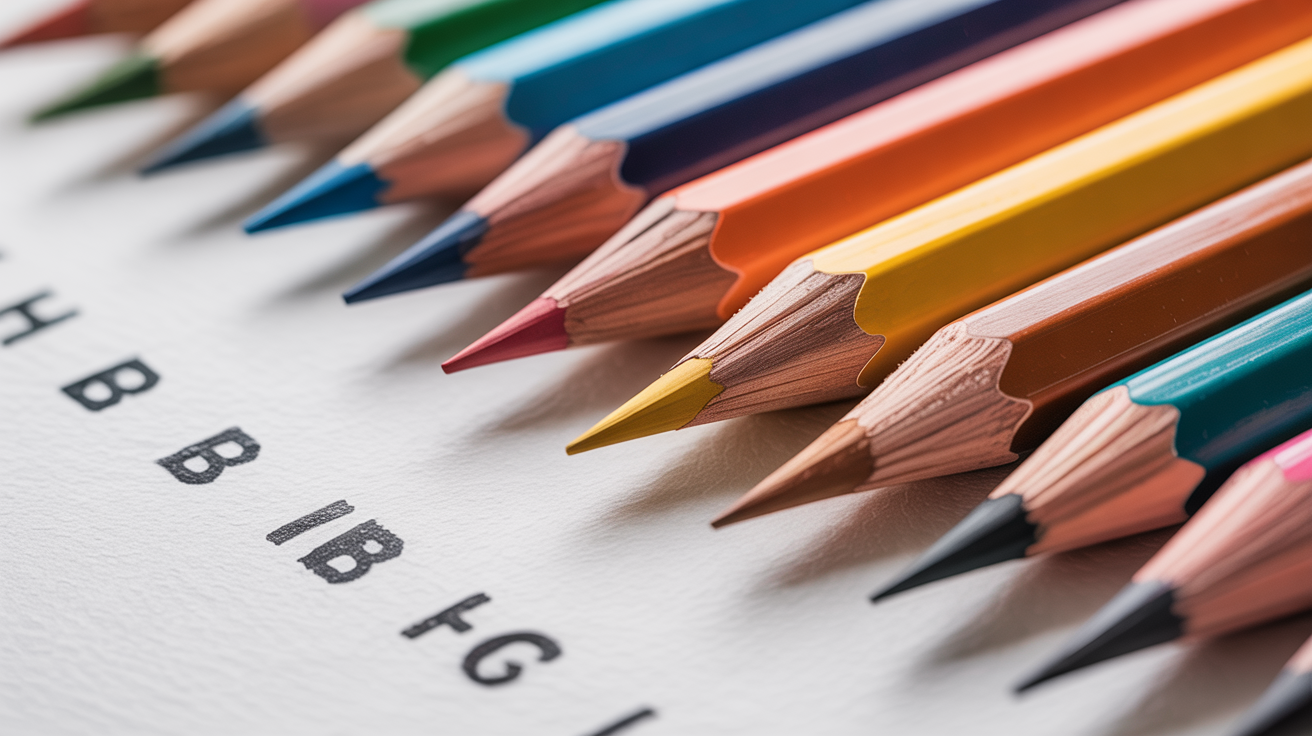
The letters and numbers stamped on a pencil's barrel tell you exactly what the graphite core inside will do. H stands for hard, which produces lighter, crisper marks. B stands for black (sometimes called soft), which lays down darker, richer graphite. HB sits right between them, and the number next to either letter tells you how far toward that extreme the pencil goes. Once that clicks, the whole grading system makes sense.
At a Glance
- H means hard and light, B means soft and dark, HB is the midpoint and roughly equal to a US #2 pencil.
- The number multiplies the effect: 9H is the palest, hardest pencil made; 9B is the softest and darkest.
- A four-pencil starter set (2H, HB, 2B, and 4B or 6B) covers nearly everything a beginner needs.
- Paper texture and hand pressure change how a grade looks as much as the grade itself does.
- If you can only own one pencil, make it a 2B: forgiving, dark enough to satisfy, and easy to lighten with less pressure.
- Work light to dark by grade (2H for structure, then softer grades for tone) to avoid smearing your own guidelines.
What the Letters Actually Mean
Graphite pencil cores are a mixture of graphite and clay. Change the ratio, and you change the mark. The system dates back to 1795, when French engineer Nicolas-Jacques Conté patented the process of mixing powdered graphite with clay and firing it into a solid rod, replacing the pure graphite sticks that earlier pencils used. That single invention, pressing graphite and clay together in different proportions, is still exactly how modern pencils are made and graded.
More clay means a harder core. Hard cores hold a fine point well and deposit less graphite per stroke, so lines come out light gray rather than deep black. These are the H-grade pencils. More graphite (and less clay) means a softer core that glides across paper and leaves a darker, smudgier line. Those are the B grades.
HB is the midpoint. In the United States, the familiar #2 pencil is essentially the HB equivalent. The #2 system is an older American grading standard, but HB is the international grading scale, and the two are close enough to treat as interchangeable. If you've ever used a standard yellow pencil for a standardized test, you've already worked with HB graphite.
There's also an F grade, which stands for "fine point." It falls between H and HB in hardness, mostly found in drafting and writing pencils. For drawing purposes, you can skip it without missing much.
Understanding the Numbers
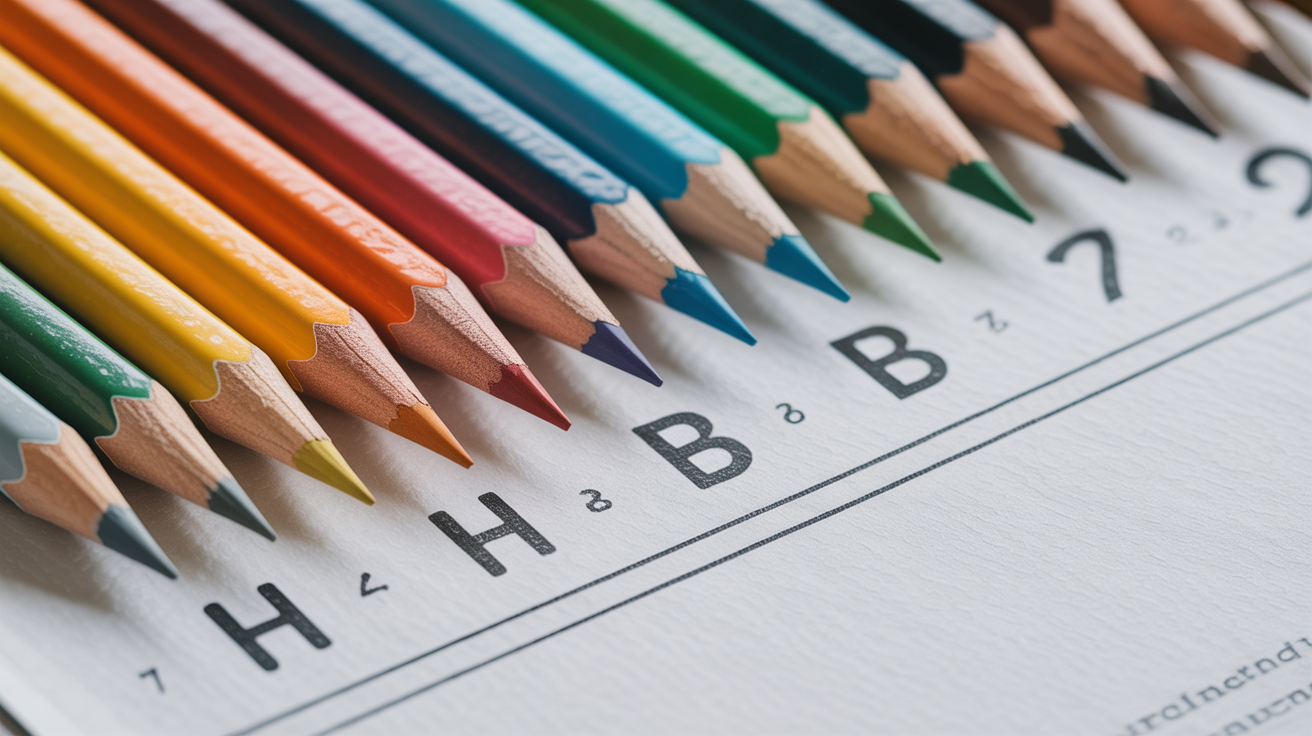
The number multiplies the quality the letter describes. So:
- 9H is the hardest, palest pencil on the scale.
- H (no number, or sometimes marked 1H) is moderately hard.
- HB is the center.
- B (no number) is moderately soft.
- 9B is the softest, darkest pencil you'll commonly find.
The jump between grades isn't always perfectly uniform across manufacturers, but the direction is always consistent: higher H numbers go lighter, higher B numbers go darker.
The Full Drawing Pencil Grades Chart
Here's how the main grades break down in practice:
| Grade | Hardness | Typical Use |
|---|---|---|
| 9H–6H | Very hard | Technical drafting, engineering drawings |
| 5H–3H | Hard | Light construction lines, precise linework |
| 2H–H | Moderately hard | Underdrawing, fine detail, light shading |
| F | Firm | Writing, crisp outlines |
| HB | Middle | General sketching, writing, all-purpose |
| B–2B | Moderately soft | Shading, expressive linework |
| 3B–5B | Soft | Deep shadows, loose gestural drawing |
| 6B–9B | Very soft | Rich dark tones, charcoal-like coverage |
Most art supply brands (Staedtler, Faber-Castell, Derwent, Caran d'Ache) follow this scale, though a 2B from one brand may feel slightly softer or harder than a 2B from another. Stick with one brand while learning so your marks stay predictable.
Which Grades a Beginner Actually Needs
You do not need the full range. A handful of grades covers almost everything a beginner will do.
A solid starter set:
- 2H for light guidelines and underdrawing that you don't want to show through later shading
- HB for general sketching and linework
- 2B for shading mid-tones
- 4B or 6B for deep shadows and rich dark areas
Four pencils. That range gives you light construction lines on one end and bold darks on the other, with enough gradation in between to build full tonal drawings.
If you can only buy one pencil to start, buy a 2B. It's forgiving, versatile, and dark enough to produce satisfying marks. You can always lighten a 2B line by applying less pressure, but an H-grade pencil can't go darker than its core allows.
Here's how that same four-pencil set maps onto real subjects:
| Pencil | Where It Does the Work | Example Subject |
|---|---|---|
| 2H | Faint construction lines, proportions, perspective grids | Blocking in a portrait before shading |
| HB | Confident outlines, everyday sketching, linework that will show | A quick gesture sketch or comic-style inking guide |
| 2B | Mid-tone shading, skin, fabric folds, soft shadow transitions | Shading a face or a folded shirt |
| 4B–6B | Deep shadow pockets, hair, fur, near-black backgrounds | The dark side of a still life or a pet's dark coat |
For a broader overview of what to stock when you're starting out, the guide to the best drawing supplies for beginners covers pencils alongside the other tools worth owning.
How Paper and Pressure Change Everything
The grade printed on your pencil isn't the whole story. Two other variables shape the mark: paper texture (called tooth) and how hard you press.
Tooth refers to the roughness of the paper's surface. A heavily textured paper (high tooth) grabs more graphite per stroke, making any pencil look darker and more granular. Smooth paper lets the pencil glide, producing finer, lighter marks. A 4B on hot-press smooth paper behaves differently than a 4B on rough watercolor paper.
Pressure gives you a range within a single grade. A 2B pressed lightly reads almost like an HB. The same pencil pressed firmly fills the paper's tooth and reads almost like a 4B. Practicing pressure control is genuinely more valuable early on than owning a wide range of pencils.
That interplay between grade, tooth, and pressure is also why pencil behaves so differently from charcoal, which sits on the surface of paper rather than bonding into it. If you're curious how the two compare for drawing, graphite vs charcoal: which should a beginner use lays out the practical differences.
Choosing the right paper matters too. The best paper for pencil drawing and sketching explains how paper weight and texture affect your marks in ways that change which grades feel right.
A Note on Layering Grades
One technique worth knowing early: many artists build drawings by working light to dark, starting with harder grades for structure and switching to softer grades as they develop tone. A 2H sets down barely-there guidelines. An HB firms up the lines worth keeping. A 4B or 6B fills the shadows.
This works because harder graphite doesn't smear into the tooth ahead of it the way a heavy 6B pass would. Layering this way gives more control than trying to do everything with a single grade.
Common Grade-Selection Mistakes
A few patterns trip up beginners specifically:
- Buying a 12-pencil set and using only three of them. Full sets (9H through 9B) look thorough but most of the range sits unused. Start with four pencils and add grades only when you hit a wall a pencil you own can't solve.
- Reaching for a softer pencil instead of pressing harder. If a 2B feels too light, try more pressure before switching to a 4B. Grade and pressure both control darkness, and pressure is free.
- Using a soft grade for underdrawing. A 4B guideline is nearly impossible to erase cleanly and will muddy your shading later. Keep construction lines in 2H or H.
- Storing pencils near heat. The wood casing can warp and the graphite core can crack invisibly inside, so the pencil snaps the first time you sharpen it. A drawer or pencil case out of direct sun is enough.
- Sharpening soft grades to an aggressive point. 4B and softer cores are physically weaker; a long, thin point breaks almost immediately under normal drawing pressure. A slightly blunter point lasts longer on soft grades.
Frequently Asked Questions
What's the difference between HB and a #2 pencil? Essentially nothing. The #2 designation is an older American grading system where #2 corresponds to medium hardness. HB is the equivalent international grade. They're not identically standardized, but in practice they behave the same way.
Why do some pencils have no letter, just a number like "3"? Some manufacturers, especially older ones or those making general writing pencils, use a simplified numeric scale (1 through 4) instead of the H/B system. In that scale, 1 = B, 2 = HB, 2.5 is close to F, 3 = H, and 4 = 2H. It's less precise than the full artist's scale.
Can I use H-grade pencils for shading? You can, but they resist smooth gradation. Hard grades skip across paper tooth and tend to look streaky in shadow areas rather than rich and velvety. For shading, softer grades (2B and above) blend more naturally.
Why do soft pencils go blunt so fast? Soft graphite cores contain more graphite and less clay binder, so the core is physically weaker. It wears down faster against paper and is more prone to snapping under pressure. Sharpen often and press lightly, especially with grades of 4B and softer.
Do I need specialty drawing pencils, or can I just use school pencils? Standard school pencils work fine for learning the basics. The main advantage of artist-grade pencils (like Staedtler Mars Lumograph or Faber-Castell 9000) is consistency and a wider grade range. A school HB and an artist HB produce similar marks; the real gap opens when you need 6B or 2H, grades that school supply lines don't carry.
Is a mechanical pencil's lead graded the same way? Mostly yes. Mechanical pencil leads commonly come in HB, 2B, and occasionally H or 2H, using the same letter logic. The practical difference is thickness (0.5mm or 0.7mm is standard) rather than grade range, so mechanical pencils are better for consistent linework than for wide tonal shading.