Subjects & Projects
How to Draw a Simple Still Life
Learn how to draw a still life step by step. Set up objects, measure proportions, and build form with shading. A beginner-friendly guide with practical tips.
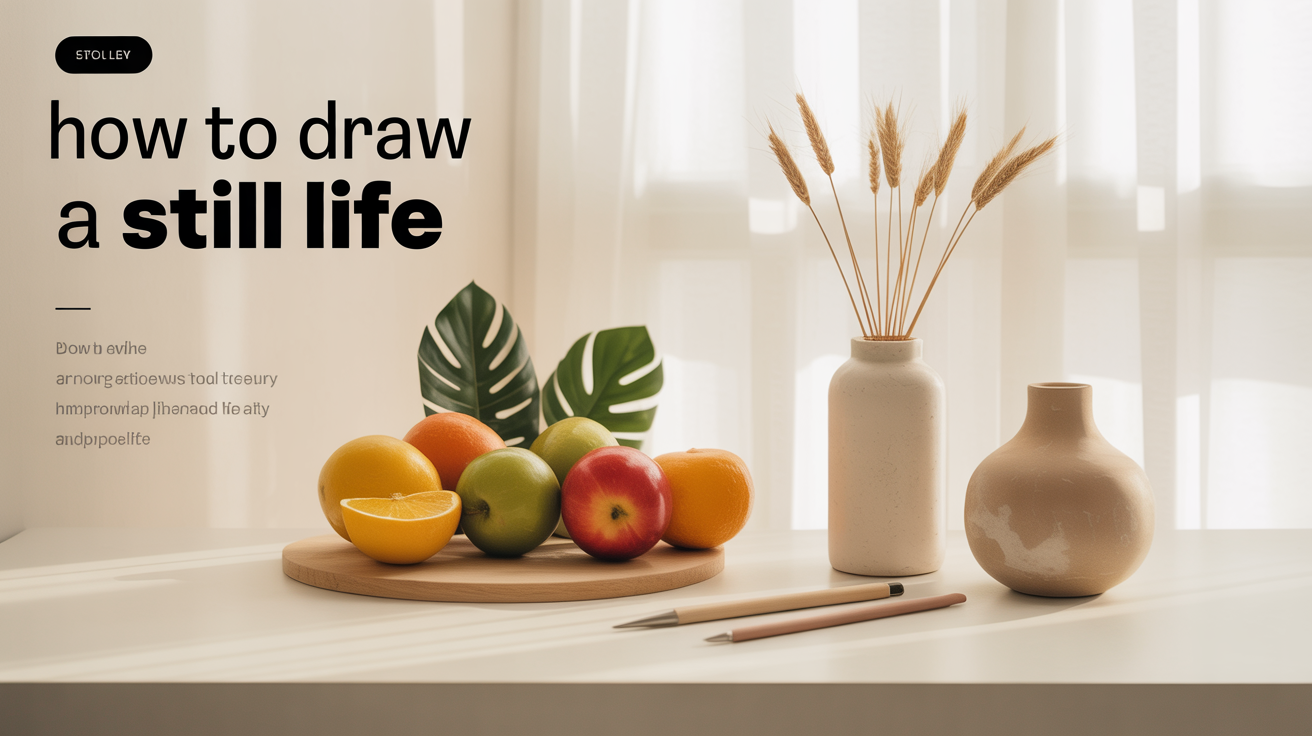
Still life drawing has been a training ground for artists for centuries, and for good reason. The objects sit perfectly still, the light does not move (if you work from a lamp rather than a window), and you can take as long as you need. That makes still life one of the best starting points for practicing the core skills of observation: measuring proportion, understanding form, and building volume through shading.
This guide walks through a complete beginner process, from choosing your objects to adding the final shadows. You will need a pencil (an HB or 2B works well to start), an eraser, and a piece of drawing paper. Nothing else is required.
Choosing and Arranging Your Objects
For a first still life, keep the group small. Two or three objects are plenty. Good candidates are things with simple, readable shapes: a mug, an apple, a small book lying flat, or a short candle. Avoid objects with complex patterns or reflective surfaces for now.
When you arrange the objects, think about a few things:
- Overlap at least one pair of objects. When items overlap, they create a sense of depth. A scene where everything sits side by side in a row looks flat.
- Vary the heights. A tall object next to a shorter one is more interesting than two items of identical height.
- Use a light source you can control. A desk lamp placed to one side gives you a clear shadow side on each object, which makes shading much easier to understand.
Step back and look at your arrangement from where you plan to draw. Squint your eyes slightly. This blurs fine detail and lets you see the overall shape of the group as one unit.
Measuring and Blocking In the Shapes
Before drawing any curves or details, spend a few minutes measuring. Hold your pencil out at arm's length to compare the height and width of each object.
Ask yourself:
- Is the mug taller than it is wide, or about the same?
- How does the height of the apple compare to the height of the mug?
- How far apart are the objects?
Once you have a rough sense of the proportions, lightly sketch the basic geometric shapes that match each object. A mug is roughly a cylinder (an oval on top, an oval on the bottom, joined by vertical lines). An apple is close to a sphere with a slight dent at the top. A book is a flat rectangle.
Use a very light touch at this stage. An HB pencil with minimal pressure leaves marks you can erase without a trace. Keep these construction lines loose, not precious. Their only job is to map out the space.
Drawing the Contours
With your basic shapes placed, you can start refining the outlines. This is where you slow down and look carefully at the actual object rather than the idea of it in your head.
A mug, for example, is not a perfect cylinder. The rim often flares out slightly. The handle has thickness and attaches at two points. The bottom may sit on a small foot ring. Draw what you actually see, not what you assume.
A few practical tips for this stage:
- Draw through your objects. Sketch the full ellipse of the mug's top even though the body of the mug will cover part of it. This helps you place the rim correctly.
- Check your angles often. A line that looks straight while you are drawing it can look slanted when you pull back.
- Do not erase constantly. Let the page collect your exploratory lines and clean up later.
For a deeper look at how to measure and check proportions while drawing, the same technique applies when you learn to draw a face.
Adding Value to Create Form
Value means the range from light to dark. Without value, a drawing stays flat. Adding shading is what turns a circle into a sphere and a rectangle into a box.
Before you shade, identify where your light source is. Every object in the scene has a light side (facing the lamp) and a shadow side (facing away). There is also a cast shadow on the surface below each object.
Work through shading in this order:
- Identify the lightest areas and leave those untouched (or nearly so).
- Apply a light, even layer of hatching (parallel lines) to the mid-tone areas. Hatching means drawing closely spaced lines; the closer they are, the darker the tone.
- Build darker tones in the shadow areas by going over your hatching again, or adding a second layer of lines in a different direction (cross-hatching).
- Darken the cast shadows on the table surface beneath each object. Cast shadows are usually darkest right where they touch the object and fade as they move away.
Work gradually. It is easy to add more graphite but harder to take it back. An HB is good for lighter tones; switching to a 2B gives you deeper darks without having to press very hard. Pressing too hard compresses the paper's tooth (texture) and makes further layering difficult.
If you want to explore shading more deeply after this project, the same principles of value and edge quality come into play when you work on how to draw eyes that look real.
Finishing and Evaluating Your Drawing
Once you have established the main areas of light and shadow, step back from the drawing. Hold it at arm's length, or prop it up and look at it from across the room.
Compare it to the actual setup. Ask:
- Do the proportions of each object look correct relative to the others?
- Is the light direction consistent across all the objects?
- Are the cast shadows present and dark enough to anchor each object to the surface?
At this stage you can make targeted adjustments. Lighten an area with a kneaded eraser (a soft, pliable eraser you can shape into a point), which lifts graphite without scrubbing. Darken areas that need more contrast.
Shaky lines and imperfect curves are part of the process, not failures. Most beginning drawings look stiff or slightly off in proportion, and that is exactly how it is supposed to go. Every drawing you finish gives your hand and eye more data to work with next time.
Frequently Asked Questions
What objects should a beginner use for a first still life?
Simple, matte-surfaced objects with clear, readable silhouettes work best. A mug, a piece of fruit, a small block or book, and a bottle are all good choices. Avoid very shiny objects (they require understanding complex reflections) or objects with intricate patterns.
Do I need a special drawing paper for still life practice?
Standard cartridge paper or copy paper is fine for practice. If you want something that handles multiple layers of graphite well, a smooth bristol or medium-tooth drawing paper holds up better to repeated erasing. Paper weight of around 80-100 gsm (grams per square meter) is a practical starting point.
How do I keep my still life setup consistent if I draw over multiple sessions?
Use tape to mark the position of each object on the table so you can put everything back exactly. Photograph the arrangement with your phone before you stop for the day, especially if you are using natural light, since sunlight shifts position and quality hour to hour.
My objects look flat even after shading. What am I missing?
Flat-looking objects usually need more contrast between the lightest and darkest areas. Make your shadows genuinely dark rather than a light grey. Also check that you have included the cast shadow on the surface below each object. That shadow is what visually connects the object to the surface and keeps it from looking like it is floating.
Can I use reference photos instead of drawing from real objects?
Yes, though drawing from a real physical setup is better practice when possible. A three-dimensional object gives you accurate information about how the light behaves and lets you shift your viewpoint if something looks unclear. Photos flatten the scene and sometimes distort proportions through the lens. If you do use a photo, make sure it is well-lit with visible shadows.
Once you are comfortable with simple geometric objects, you can bring the same observation process to more complex subjects. Drawing hands is a good next challenge since hands involve multiple overlapping forms and require the same careful measuring you practiced here.