Subjects & Projects
How to Draw Hands (Without Them Looking Wrong)
Learn how to draw hands step by step with this beginner-friendly guide. Simplify the palm, nail proportions, and avoid the most common mistakes.
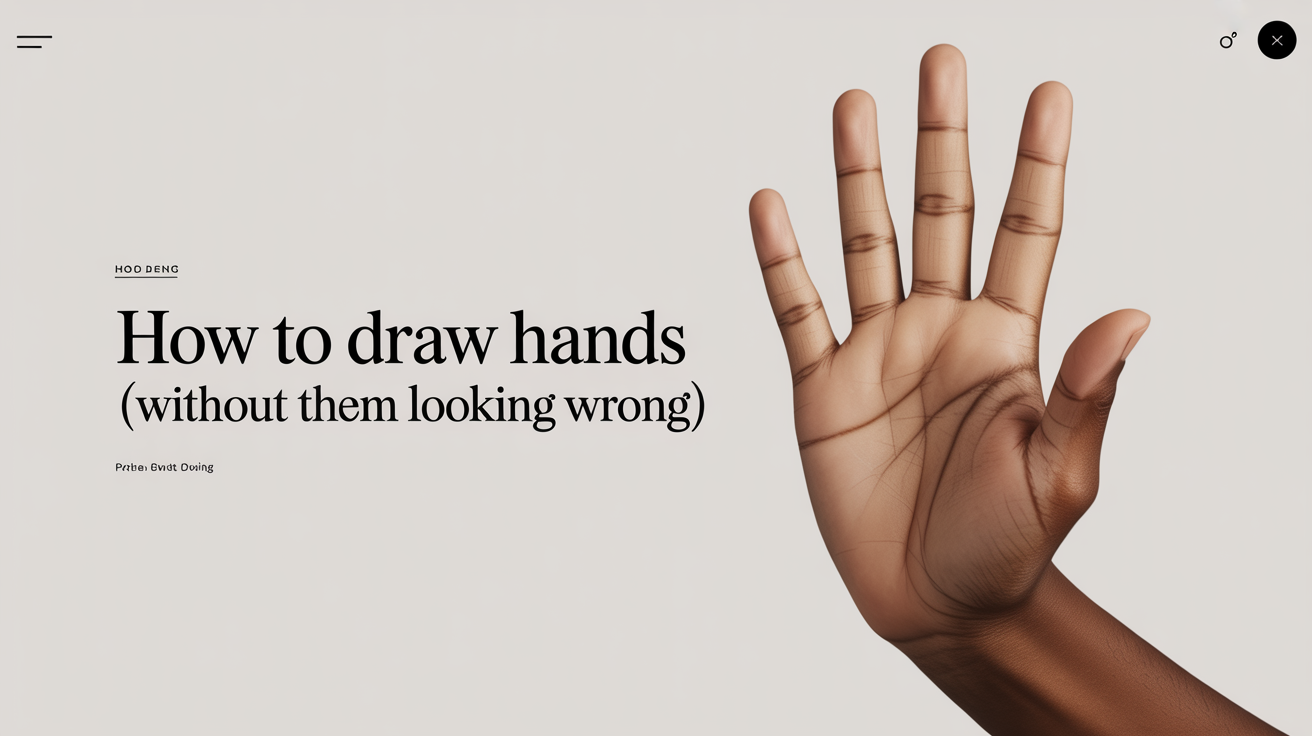
Hands are the part most beginners quietly hide behind a character's back. That habit makes sense, because hands are genuinely complex, but the fix is simpler than it looks: break the hand into two big shapes before you draw a single finger. Once you see those shapes, the rest follows a system.
Why Hands Feel So Hard (And Why They Don't Have to Be)
The hand has 27 bones, but you don't need to memorize anatomy. What makes hands difficult is that most people try to draw all five fingers at once, starting from the tips and working backward. That approach collapses almost immediately because fingers are not independent tubes. They grow out of a shared block of flesh, and that block controls everything else.
The second problem is proportion. Without a reference, most beginners draw fingers that are either too long (spider-hand) or too short (cartoon-mitt). A few measurements fix both issues.
The Two Shapes That Simplify Everything
Think of the hand as two parts:
The palm block. This is a rough rectangle or trapezoid, wider at the knuckles than at the wrist. For an average adult hand, the palm block is roughly square. It is not flat; it has thickness, like a thick paperback book.
The finger section. The four fingers attach along the top edge of the palm block. The thumb attaches to the side of the block, lower down, with a wide range of motion.
Start every hand drawing with these two shapes in place before adding detail. That single habit removes most of the "wrong" from a hand drawing.
Proportions Worth Memorizing
Getting proportions right is how you get from "recognizable" to "convincing." Here are the ones that matter most for beginners:
- Palm height vs. finger length. The four fingers (middle finger to fingertip) are approximately equal in length to the palm. The hand is roughly half palm, half fingers.
- Finger length order. The middle finger is longest. The index and ring fingers are close in length (ring is often very slightly shorter). The pinky reaches roughly to the first knuckle of the ring finger.
- Knuckle spacing. The knuckles do not form a straight line. They arc gently, with the middle knuckle sitting highest. This arc is called the knuckle line, and drawing it as a gentle curve (not flat) immediately makes hands look more natural.
- Fingernail placement. Nails sit on the back face of the fingertip, not on the very tip. They cover roughly the top third of the last finger segment.
- Thumb. The thumb is short and wide compared to the fingers. Its base joint sits well below the knuckle line of the other four fingers.
These numbers are averages. Hands vary by age, build, and genetics, which is exactly why your own hand is the best reference you have.
Drawing Hands Step by Step: A Relaxed Open Hand
This sequence works for a hand seen from the back (dorsal view), slightly angled, fingers loosely extended. For other poses, the same logic applies; only the shapes change.
-
Draw the palm block. Sketch a loose trapezoid, wider at the top (knuckle side) than at the bottom (wrist). Keep it light. It should feel like a thick, slightly squashed rectangle.
-
Mark the knuckle line. Along the top edge of the trapezoid, draw a gentle upward arc. This arc is where the fingers will attach. The highest point of the arc sits above the middle finger position.
-
Place the four finger cylinders. From the knuckle arc, draw four slightly tapered tubes. Keep them parallel but not perfectly so, since relaxed fingers splay a little. Each finger has three segments divided by two visible knuckles (the middle joint and the finger-knuckle closest to the tip).
-
Add the thumb. The thumb attaches to the lower-left side of the palm block (for a right hand). It has two segments visible from this angle, and its knuckle sits below and away from the other knuckles. The fleshy base of the thumb (the thenar eminence) adds a rounded bulge to the palm's inner edge.
-
Refine the silhouette. Erase or lighten the original trapezoid. Soften the transitions where the fingers meet the palm. The webbing between fingers sits roughly one-third of the way up the finger, not at the base.
-
Add light structure lines. Draw the two visible knuckle creases on each finger. Add the main palm crease that runs diagonally from below the index finger toward the wrist. Keep lines light; hands have soft edges, not hard lines everywhere.
-
Check against your reference. Hold up your own hand in the same pose and compare. Your hand is always available, and it is always accurate.
Drawing Fingers and the Thumb
Fingers are not uniform cylinders. Each segment is slightly wider at the knuckle and tapers gently toward the next joint. The fingertip itself widens again into a small pad before the nail.
When fingers bend, the segments compress on the inside of the bend and stretch on the outside. The knuckle protrudes when the finger closes into a fist, which is why a clenched fist looks bony across the back of the hand.
For the easy way to draw hands in a fist: draw a rounded rectangle (the curled fingers) sitting on top of the palm block. The thumb wraps around the outside. This approach sidesteps the problem of drawing five individual bent fingers and gets the overall shape right first.
The thumb deserves extra attention. It moves on a saddle joint, so it can swing across the palm, away from it, and rotate in ways the other fingers cannot. Because of this, the thumb's knuckle line reads differently depending on the angle. From the front, the thumb's base pad (the thenar eminence) fills the lower half of the palm's inner edge. From the side, the thumb sticks out at roughly a 45-degree angle from the palm in a natural resting position.
A related challenge is drawing faces and heads in proportion. The same shape-first logic that helps with hands also helps when you are working through how to draw a face with beginner proportions and a step-by-step method, so the two skills reinforce each other.
Using Your Own Hand as a Live Reference
This is the cheat code that professional illustrators use constantly. Your hand is free, always available, poses on demand, and is exactly the right size. Here is how to use it well:
Mirror your pose. If you are drawing a right hand, pose your left hand in the same position. They are close enough in shape to be useful references for each other.
Change the light source. Hold your hand under a desk lamp to get strong shadows across the knuckle planes. Shadows reveal structure faster than any diagram.
Photograph, then draw. Take a photo of your hand in the pose you need. Drawing from a still photo is much easier than holding a pose while glancing back and forth.
Rotate slowly. Spend 60 seconds rotating your hand through different angles while watching how the silhouette changes. This mental model, built from direct observation, is more useful than memorizing anatomy charts.
For full-body poses where hands connect to arms and shoulders, drawing the human figure for beginners covers how to proportion the whole body so hands end up in the right place relative to elbows and hips.
Common Mistakes to Avoid
- Drawing fingers as sausages. Fingers taper and have visible segment breaks. Add the knuckle creases.
- Making the palm too narrow. The palm is wider than most beginners expect, especially across the knuckles.
- Ignoring the knuckle arc. A flat row of knuckles looks artificial. The arc is subtle but important.
- Placing the thumb too high. The thumb attaches below the knuckle line, not alongside it.
- Forgetting the webbing. The skin between fingers creates a visible V-shape. Leaving it out makes fingers look glued together.
- Skipping the palm crease. Even a single diagonal line across the palm adds enormous realism.
- Over-detailing too early. Nail shapes and wrinkle lines should come last, after the main proportions are correct.
The same patient, structure-first approach that works for hands also applies to smaller features. If eyes are giving you trouble alongside faces, how to draw eyes that look real walks through the same kind of shape-breakdown method.
Frequently Asked Questions
How long does it take to get good at drawing hands? Most beginners see noticeable improvement after 20 to 30 focused hand studies drawn from a real reference. "Good" is relative, but being able to draw a convincing relaxed hand or loose fist is achievable within a few weeks of regular practice.
Should I trace my own hand to practice? Tracing is fine as a warm-up to understand the silhouette, but it does not build the skill of constructing a hand from imagination or from a different reference. Use tracing to study the shape, then try to redraw it without the trace.
Why do my fingers always look too long? The most common cause is starting the fingers at the very top edge of the palm instead of letting the palm block extend high enough. If you draw the full palm trapezoid first, the fingers will automatically start from a better position. Also check that your palm block is tall enough; a short palm block forces the fingers to do too much work.
Do I need to study anatomy to draw hands well? Not in depth. Knowing the names of the bones helps if you want to study advanced resources, but for the purposes of drawing convincing hands you only need to understand the palm block, the three finger segments, the knuckle arc, and the thumb's separate range of motion.
What is the easiest hand pose to start with? A relaxed open hand, viewed from a slight three-quarter angle from the back, is probably the most forgiving starting point. The fingers are extended and visible, nothing is foreshortened severely, and the palm block reads clearly. Once that feels manageable, try a loose fist, then a pointing finger, then more complex poses.