Drawing Basics
How to Draw Straight Lines and Smooth Curves by Hand
Learn how to draw straight lines and smooth curves freehand using shoulder movement, ghosting technique, and simple line control exercises.
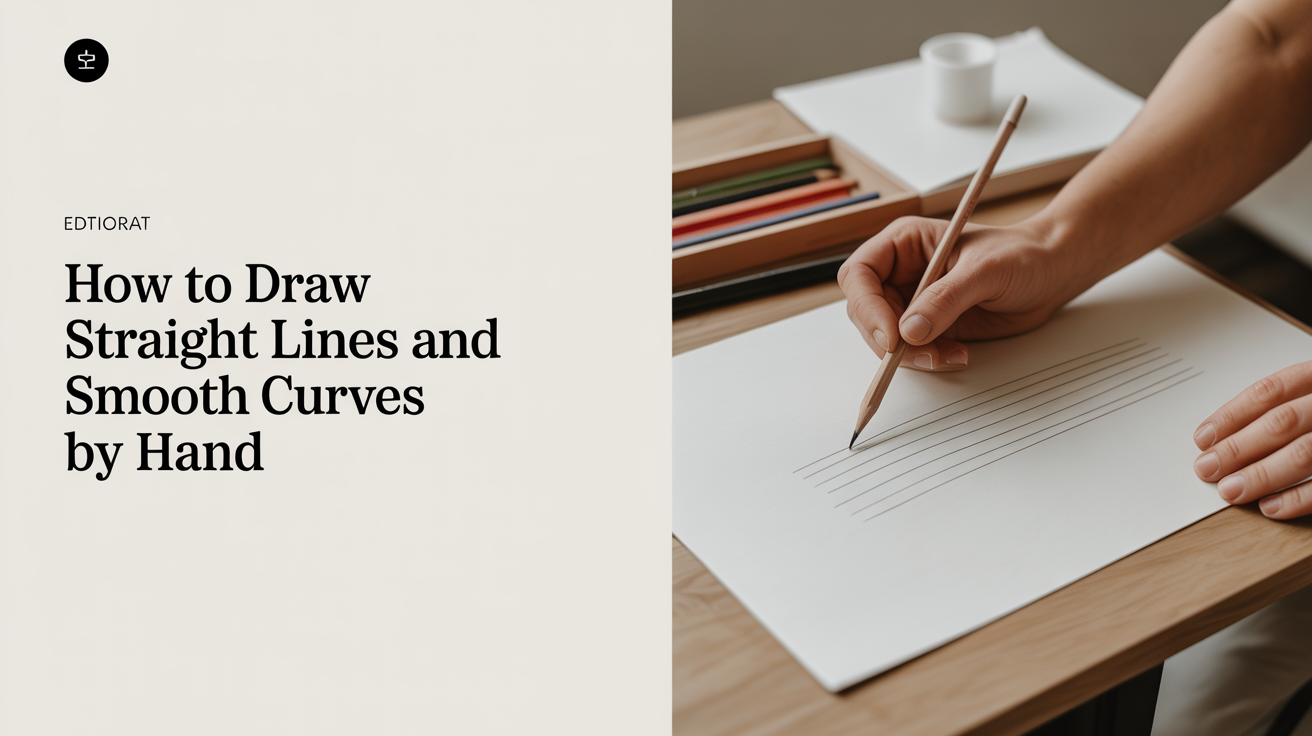
The secret to drawing straight lines and smooth curves freehand has nothing to do with having a steady hand. It's about which part of your arm does the work. Draw from the shoulder and elbow, not from your fingers and wrist, and your lines will immediately become more confident. Pair that with a technique called ghosting (rehearsing the stroke in the air before touching paper) and you'll see improvement within a single practice session.
Why Your Wrist Is Working Against You
Most beginners instinctively grip the pencil tightly and steer the mark with their fingers. This feels precise, but it actually produces short, twitchy strokes that wobble and veer off course. Your fingers have a tiny range of motion, so any small tremor gets amplified in the line.
When you anchor movement in the shoulder joint instead, you're using a much larger pivot point. The line travels in a smooth arc that the smaller muscles of your hand can't replicate on their own. The elbow adds a middle pivot for medium-length straight marks, while the shoulder handles long sweeping strokes.
Try this right now: hold your pencil loosely, rest your hand lightly on the paper, and drag a line by moving only your shoulder. The difference is usually immediate and a little surprising.
How to Hold the Pencil for Better Line Control
For line-work practice, hold the pencil further back from the tip than you normally would (about two-thirds of the way up the barrel). This reduces the leverage your fingers have over the tip, which actually helps. A tripod grip (thumb, index, middle) is fine. The goal is light contact, not control through pressure.
Keep your wrist loose. If you notice your wrist tightening during a stroke, you've defaulted back to finger-driving.
The Ghosting Method, Explained
Ghosting means rehearsing a stroke two or three times in the air just above the paper, then lowering the pencil and executing the mark with exactly the same motion. The rehearsal lets your arm learn the trajectory before any graphite commits to the page.
Here's how to do it:
- Set your start and end points. For a straight line, mark two small dots. For a curve, mark the two endpoints and lightly indicate the arc you want.
- Position your pencil above the start point without touching the paper.
- Swing your arm through the full stroke path two or three times, stopping where you want the line to end. Keep the motion fluid and confident.
- On the final repetition, lower the pencil so the tip touches the paper at the start point, and complete the stroke in one continuous motion.
- Lift cleanly at the end. Don't decelerate into a drag.
The most common mistake is slowing down partway through out of caution. A hesitant stroke shows the hesitation. Committing to the motion is what produces a clean line.
Drawing Straight Lines Freehand
A perfectly mechanical straight line is what rulers are for. What you're after is a line with intention, one that reads as straight to the eye and carries a consistent weight. That's an achievable skill.
The Pivot-Point Technique
For longer straight lines, pick a fixed anchor point at one end (your destination) and keep your gaze there rather than watching the pencil tip. This is the same principle used in drawing contour lines: your hand follows where your eye leads. When you focus on where the line is going rather than where it currently is, the stroke self-corrects toward the target.
For lines under about four inches, the elbow is the main pivot. For longer marks, let the shoulder take over and allow the elbow to straighten slightly as the stroke travels.
Straight-Line Drill: The Parallel March
This is one of the best line-control exercises for building consistency. Fill a page with parallel horizontal lines, spacing them roughly half an inch apart. The goal is not perfectly equidistant lines (that's a separate ruler exercise). The goal is to feel your arm moving in a controlled arc each time, maintaining similar length and pressure across strokes.
Work top to bottom, then rotate the page 90 degrees and repeat going left to right. Rotating the page matters because you have a natural direction where your shoulder mechanics feel easiest (for most right-handers, lines that travel from bottom-left to top-right feel most natural). Doing the drill in multiple orientations builds control in all directions rather than just your comfortable angle.
Drawing Smooth Curves by Hand
Curves follow the same logic as straight lines: move from a larger joint, ghost first, and commit to the stroke. The main difference is that curves require a natural arc, and your arm already makes natural arcs. The challenge is directing them accurately.
Using Your Shoulder as a Compass
Your shoulder joint is a ball-and-socket joint that rotates through a consistent arc. If you fix your elbow and wrist and move only from the shoulder, you will draw a curve. By adjusting how far you extend your arm and how much shoulder rotation you allow, you can modulate the radius of that curve.
Long, gradual curves work best when the motion comes entirely from the shoulder. Tighter curves often require rotating the paper so that the arc you're drawing still lines up with your shoulder's natural sweep. Rotating the paper is not a cheat; it's what professional illustrators do routinely.
The Pivot-and-Anchor Method for Tight Curves
For small curves (like the curve of a mouth or the inside of an ear), rest a different finger (often the ring finger or pinky) lightly on the paper as an anchor point. Your wrist then rotates around that anchor, producing a tighter controlled arc. This is the one situation where wrist movement is actually useful, because the anchor constrains it to an intentional radius.
Practice this by drawing small arcs and circles: draw a circle by anchoring your pinky at center and rotating at the wrist, or by pivoting at the elbow in one continuous motion rather than assembling it from short segments.
Line-Control Exercises to Practice Daily
Consistent improvement comes from short, regular practice rather than occasional long sessions. The following drills each take five to ten minutes and target different aspects of line control. Work through this list at the start of a drawing session as a warm-up.
| Exercise | What to do | What it trains |
|---|---|---|
| Parallel march | Fill a page with evenly-spaced parallel lines in 4 orientations | Shoulder-driven straight strokes, pressure consistency |
| Box grid | Draw a 6x6 grid freehand (no ruler) | Parallel lines + perpendicular accuracy |
| Arc sweep | Draw a series of arcs from a shared endpoint, varying the radius | Smooth curve production from the shoulder |
| Ellipse loops | Draw overlapping ellipses without lifting the pencil | Continuous stroke confidence, wrist pivot |
| Connect-the-dots | Mark 10 random dot pairs; draw a line through each pair | Accuracy toward a target (gaze-ahead training) |
| Hatching gradients | Fill a rectangle with parallel hatching, lightening pressure as you go | Pressure control across a stroke |
Start with the parallel march and box grid for the first week. Add arc sweeps and ellipse loops once the straight lines feel more natural.
These drills pair naturally with gesture drawing practice, where fast confident strokes are more valuable than fussy perfection.
Putting It Together: From Drills to Actual Drawing
The purpose of isolated drills is to build muscle memory that transfers into your real drawings without conscious effort. Once your shoulder-driven stroke starts to feel automatic, you'll notice that sketching figures, objects, or landscapes feels less like fighting the pencil.
One useful bridge exercise: draw simple subjects (a mug, a book, a chair) using only long deliberate strokes, ghosting each line before you commit. Resist the habit of building up a line from several short scratchy marks. Each shape gets one committed stroke per edge. It will look rough at first. After a few sessions, the strokes will start landing where you intended them to.
For drawings that require measuring and comparing lengths across your subject, the technique covered in how to measure proportions when drawing complements line control well: once your marks go where you aim them, accurate proportions become much easier to achieve.
Wobbly lines are completely normal at the start. They don't mean you lack talent or coordination. They mean your arm hasn't learned the movement yet. The drills above are designed specifically to teach it that movement, and most people notice real improvement within three or four short sessions.
Frequently Asked Questions
Why do my freehand lines always curve slightly even when I want them straight?
This is the shoulder arc at work. When you move from the shoulder, you naturally draw an arc rather than a perfectly straight line. To counteract this, try locking the shoulder slightly and using more elbow on medium-length lines, or work with your page at an angle that puts the line you need inside your most natural straight-arc direction. Rotating the paper so the line runs from bottom-left to top-right (for right-handers) usually produces the flattest arc.
How long does it take to see improvement in line control?
Most beginners notice a meaningful difference after three to five focused practice sessions of 10 to 15 minutes each. The ghosting technique tends to produce visible improvement in the same sitting because it changes your approach immediately, not just your muscle memory over time.
Should I use a mechanical pencil or a wooden pencil for line control practice?
Either works. A mechanical pencil with 0.5mm HB lead keeps a consistent tip, which removes line-width variation as a variable while you're learning. A wooden pencil lets you explore how pressure and tip angle affect line weight, which is useful but adds another thing to manage. Start with whichever you're most comfortable holding, then experiment once your basic control improves.
Is it bad to draw a line in multiple short strokes instead of one long one?
Short overlapping strokes (sometimes called "chicken scratching") can produce a loose, energetic texture that has its place in sketching. But relying on them because you can't produce a confident single stroke is a habit worth addressing. The drills above specifically train you to commit to full strokes so that short strokes become a stylistic choice rather than a fallback.
My hand shakes a little even when relaxed. Will that always show in my lines?
A small tremor affects lines drawn slowly and carefully far more than lines drawn with a quick, committed movement. The ghosting method and shoulder-driven strokes both favor faster, more confident marks, which actually reduces the visible effect of any natural hand tremor. Most people find that drawing faster (within reason) produces cleaner lines than drawing slowly and carefully.