Drawing Basics
Contour Drawing for Beginners (and Blind Contour)
Learn contour drawing for beginners: what it is, how blind contour works, and a step-by-step exercise to sharpen your hand-eye coordination fast.
Contour drawing means tracing the edges and surface ridges of a subject in a slow, deliberate line, no shading, no fill, just the outline as your eye observes it. It is one of the oldest drawing exercises in art education, and for good reason: it forces you to really look at what you are drawing rather than what you think something looks like. Even a few sessions of contour practice will change how you see.
What Is Contour Drawing?
The word "contour" comes from the French for "outline," but in drawing it means something more precise than just a silhouette. A contour line follows the edges you can see, the outer boundary of a hand, yes, but also the ridge of a knuckle, the fold of a sleeve, the lip of a coffee mug. You are tracing every edge that a surface presents to your eye.
This is distinct from gesture drawing, which captures the energy and movement of a pose in quick marks. Contour drawing is slower and more observational. Where gesture drawing asks "what is the figure doing?", contour drawing asks "what does this edge actually look like?" Both skills reinforce each other, which is why many drawing courses teach them side by side, see gesture drawing: how to capture a pose fast for a comparison.
You do not need special supplies to start. A pencil (or even a ballpoint pen) and a sketchbook are enough. The tool matters less than the quality of attention you bring to the line.
Three Kinds of Contour Drawing
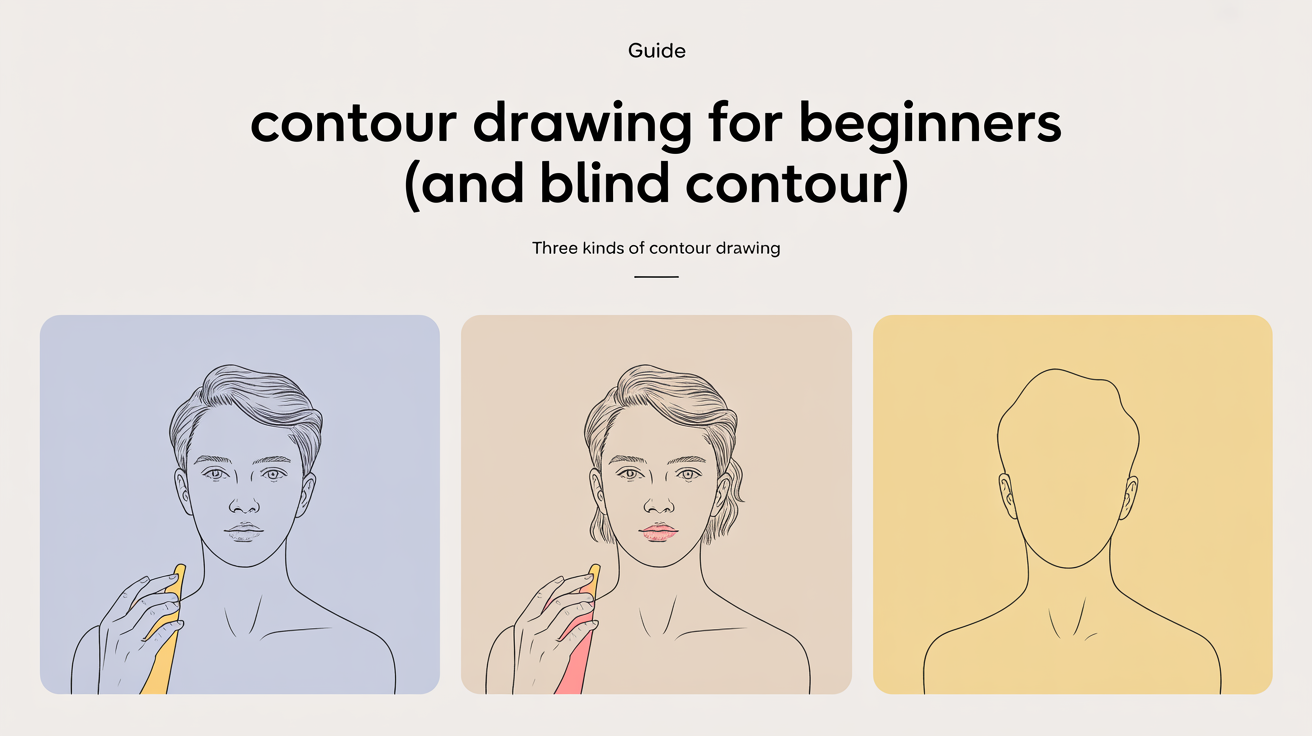
Pure contour is the strictest form: you draw only the outermost edges of your subject. No interior lines at all. This strips away detail and forces you to simplify what you see into a clean silhouette.
Continuous-line contour (sometimes called "one-line drawing") adds the rule that you cannot lift the pencil from the paper. Your line must travel over interior edges, loop back, and connect everything in a single unbroken mark. It sounds like a parlour trick, but it trains fluid, confident linework in a way that starting-and-stopping never quite does.
Blind contour drawing is the exercise most beginners encounter first, and it is worth its own section.
Blind Contour Drawing: Why It Works
In a blind contour exercise, you keep your eyes on the subject and not on the paper. Your hand moves in response to what your eye is tracing, but you do not look down to check the result until you are done.
The drawing that comes out will almost certainly look strange. Fingers will be too long. Proportions will drift. Parts of the image may float disconnected in space. This is completely normal, and it is also the point.
Blind contour breaks the mental habit of drawing what you know rather than what you see. Most beginners, when drawing a hand, draw a generic hand symbol, the shape stored in memory since childhood. Blind contour forces a reset. Because you cannot see the paper, you stop trying to make the drawing look "right" and start actually following the edges in front of you. Over time, this recalibrates the connection between your eye and your hand.
If your first few blind contours look like abstract maps, you are doing it correctly. The goal is not a recognizable drawing. The goal is the slowed-down, edge-by-edge quality of attention you practice while making it.
Step-by-Step: Your First Blind Contour Exercise
This takes about five minutes. Do it with a simple subject, your non-dominant hand works perfectly.
- Sit comfortably with your sketchbook flat on the table in front of you, pencil in hand.
- Place your non-dominant hand on the table beside the sketchbook in a relaxed, natural position.
- Put your pencil on the paper without looking down at where it lands. It does not matter where.
- Fix your eyes on the outermost edge of your hand, the side of your pinky finger, for example, and place your full attention there.
- Begin moving the pencil very slowly across the paper, in the same direction your eye is traveling along that edge. Move the pencil as slowly as your eye moves. If your eye pauses at a knuckle crease, your pencil pauses too.
- When your eye reaches a point where the edge changes direction, say, the tip of your pinky, change your pencil direction to match.
- Continue without lifting the pencil or looking at the paper. Trace every finger, every wrinkle, every visible edge until you feel you have covered the whole hand.
- Only then, look at your drawing.
Sit with the result for a moment before judging it. Notice where the proportions stretched or compressed, where the line shows genuine observation. Most beginners are surprised to find at least one or two passages in a blind contour that feel more alive than anything they have drawn carefully.
Repeat two or three times with the same hand in a different position, or move on to another subject.
Subjects Worth Practicing On
Blind contour and contour line drawing exercises work on almost anything, but some subjects teach more than others.
- Your own hand (endlessly available, infinitely varied by position)
- A shoe with laces
- A crumpled piece of paper or cloth
- A houseplant with irregular leaves
- A simple kitchen object (a fork, a teacup, a colander)
- A face in profile (harder, but very instructive)
- Tangled headphone or earphone cables
Start with objects that have clear, readable edges before moving to softer or more complex forms. Avoid very geometric objects like books or boxes early on, they do not give your eye much to follow, and the temptation to draw "the idea" of a rectangle is too strong.
Moving from Blind to Modified Contour
Once blind contour starts to feel familiar, most artists transition to modified contour: you are allowed to glance at your paper occasionally, but only briefly, and only to reorient where your pencil is. The majority of your attention still stays on the subject.
Modified contour produces drawings that are more spatially coherent than pure blind contour, while retaining the observational sharpness that makes the exercise worthwhile. It is closer to how professional artists actually draw from life, mostly looking at the subject, with periodic checks of the paper.
A good rhythm is roughly five seconds on the subject for every one second on the paper, though there is no strict rule. The goal is to keep your eyes on what you are drawing far more than on the drawing itself.
As your modified contour improves, you may want to focus on accuracy of line, specifically, drawing smooth, controlled edges rather than scratchy, uncertain ones. The techniques in how to draw straight lines and smooth curves by hand complement contour practice well, since clean linework makes contour drawings far more legible.
Measuring What You See
One limitation of early contour drawing is that it does not address proportion. You might trace every edge beautifully and still end up with a figure where the head is twice the right size. This is where measuring comes in, using your pencil as a sighting tool to compare distances before you commit them to paper.
If your contour drawings look observationally rich but proportionally off, it is worth learning basic sighting methods alongside your contour practice. How to measure proportions when drawing covers the pencil-sighting technique that most drawing instructors teach in tandem with contour exercises.
Frequently Asked Questions
How long should I spend on one blind contour drawing? Somewhere between three and ten minutes is typical. Going faster trains a kind of gestural awareness; going slower builds patience and close observation. Both are useful. Avoid spending less than two minutes, that is usually not enough time to get past the urge to peek.
Should I use pencil or pen for contour drawing? Either works, and each teaches something different. Pencil lets you erase, which can undercut the commitment that makes contour exercises effective. Pen forces you to commit every mark, which many artists find accelerates improvement. For beginners, a ballpoint pen on cheap copy paper removes the anxiety about wasting good supplies and encourages looser, more exploratory work.
My blind contour drawings look terrible. Am I doing it wrong? Almost certainly not. Blind contour drawings are supposed to look distorted, that distortion is evidence that you were genuinely following edges rather than drawing from memory. The exercise is not about the finished drawing. It is about the quality of looking you practice while making it. With repetition, you will notice the observational habits carrying over into your regular drawing even if the blind contours themselves never look "good."
How often should I practice contour drawing? Even five minutes a day makes a measurable difference over a few weeks. Many artists keep a small sketchbook nearby specifically for contour warmups before longer drawing sessions. It does not need to be a formal practice, drawing your hand while waiting for coffee counts.
Is contour drawing only for realism? Can I use it for illustration or design? Contour drawing trains observation and line confidence, both of which improve drawing in any style. Illustrators, cartoonists, and designers all benefit from the same hand-eye calibration that contour exercises build. The skills transfer even when the resulting work is highly stylized.