Subjects & Projects
How to Draw Everyday Objects From Around the House
Learn to draw everyday objects at home with this step-by-step beginner guide. Start with simple shapes, build confidence, and grow your sketching practice.
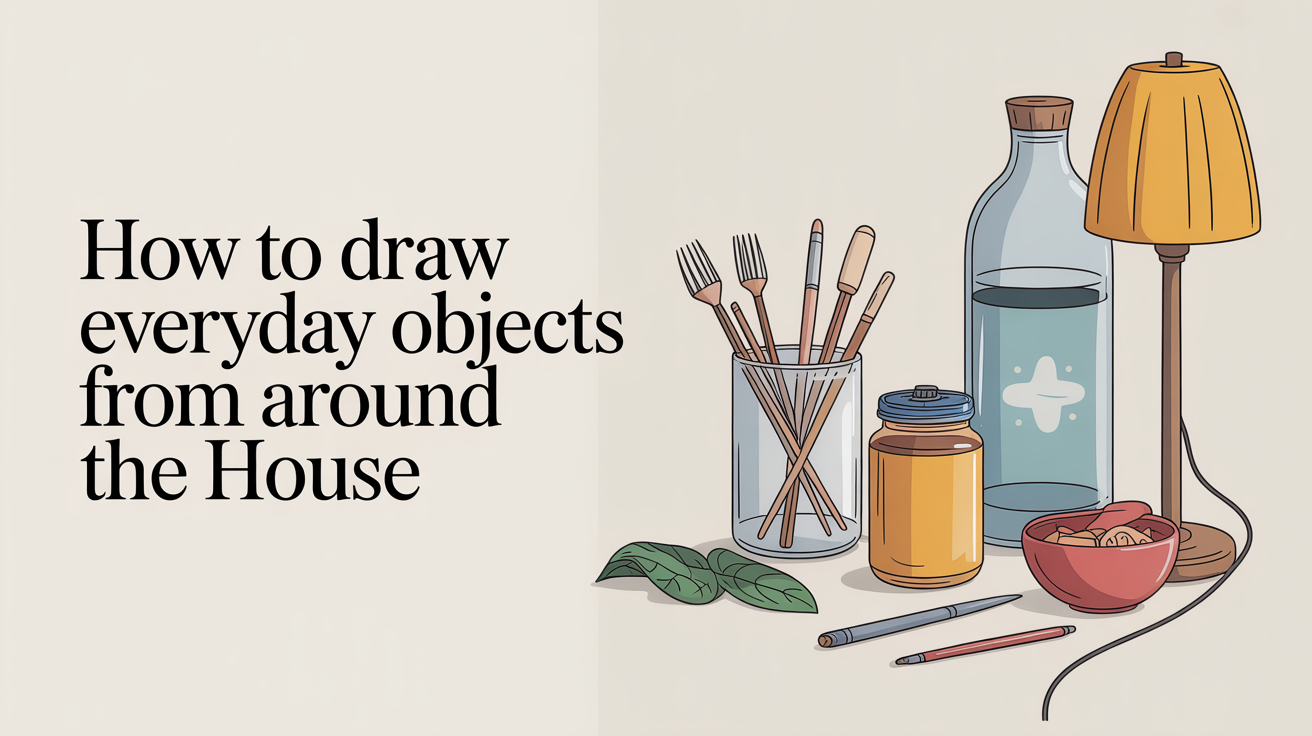
You do not need a special subject to practice drawing. The coffee mug on your desk, the shoes by the door, a bar of soap, a single piece of fruit sitting in a bowl -- these are among the most useful things you can draw, and they are already within arm's reach.
Drawing household objects trains the same core skills you would use for portraits or landscapes: seeing shapes accurately, controlling line weight, and building up form with light and shadow. The advantage over more ambitious subjects is that a mug will sit still for as long as you need it to, and if your first attempt looks wrong, you can just try again without the pressure of capturing something meaningful.
This guide walks you through a practical approach to drawing everyday objects, from choosing where to start to finishing a sketch that actually looks like the thing in front of you.
Why Household Objects Make Such Good Practice Subjects
The best thing about drawing objects around the house is that you already know what they look like. That familiarity cuts out one layer of difficulty and lets you focus on the actual drawing problem: translating a three-dimensional thing onto a flat page.
Household objects also tend to have clear, readable silhouettes. A bottle, a cup, a book -- these have strong outlines that are easy to check against your reference. When your drawing drifts off, you can see it quickly and correct it.
A few other reasons they work well:
- They stay still (unlike people or pets)
- They come in a wide range of complexity, so you can match the subject to your current skill level
- You can find new arrangements by just moving things around on a table
- Revisiting the same object weeks later shows you real progress
If you have been looking for simple things to draw for practice but feel unsure where to start, a single object on a table near a window is about as solid a starting point as exists.
Objects Sorted by Difficulty
Not all household objects are equally approachable. Below is a rough progression from straightforward to more challenging. Use the easier ones to warm up, then move into the harder ones as your confidence grows.
Beginner (start here)
- A single coin or button
- A pencil or pen
- A rectangular eraser
- A book lying flat, closed
- A bar of soap
Comfortable beginner
- A coffee mug or cup (viewed slightly from above)
- A water glass or drinking glass
- A bowl
- A single piece of fruit (apple, orange, lemon)
- A pair of scissors (closed)
Intermediate
- A sneaker or boot
- A teapot or kettle
- A candle in a holder
- A stapler or tape dispenser
- A plant pot with a plant in it
More challenging
- A bicycle helmet
- An open book with visible pages
- A pair of glasses or sunglasses
- A desk lamp
- A folded piece of fabric or a hat
Start with the beginner objects and spend real time on each one. Rushing past the simple stuff to get to more impressive subjects is one of the most common habits that slows improvement.
How to Set Up and Start a Drawing
Before you put pencil to paper, a little setup makes a significant difference.
1. Choose your lighting. Place the object near a single light source -- a window or a desk lamp. Lighting from one direction creates clear shadows, which are what give a drawing a sense of volume. Overhead fluorescent light flattens everything and makes it harder to see what you are drawing.
2. Sit at the same level as the object. Looking down steeply at a cup distorts it in ways that are hard to draw accurately. Position yourself so you are looking at the object roughly straight on, or just slightly above it.
3. Start with light pressure. Use an HB or 2B pencil and press lightly for the first marks. Light marks are easy to erase or adjust; heavy ones are not. This is not about being timid -- it is about leaving room to correct.
4. Block in the basic shape first. Before you draw any details, identify the overall silhouette. A mug is roughly a cylinder with a handle attached. A book is a rectangular block. An apple is close to a sphere with a small indent at the top and bottom. These basic forms -- called construction shapes -- are just the geometric skeleton underneath the real object.
5. Check proportions before adding detail. Hold your pencil at arm's length and use it to compare heights and widths. How tall is the mug compared to how wide? Does your drawing match? Adjusting proportions early is far easier than fixing them after you have drawn in every detail.
6. Build up detail gradually. Once the shape reads correctly, add the handle, the rim, any surface texture. Keep your marks light until you are confident in the placement.
7. Add shading last. Value (the range from light to dark) is what makes a drawing look three-dimensional. Identify where the light hits the object and where it falls into shadow. Shade the shadow areas with hatching (parallel lines) or gentle blending, and leave the lit areas light.
The Ellipse Problem (and How to Handle It)
An ellipse is the shape a circle takes when viewed from an angle -- the top of a cup, the rim of a bowl, the bottom of a bottle. Ellipses trip up a lot of beginners because they look simple but are surprisingly easy to draw incorrectly.
The most common mistake is making the ends of an ellipse too pointed, like a football. A proper ellipse has smoothly rounded ends with no sharp points anywhere around it.
A practical method for practicing ellipses: draw a horizontal line, then try to draw a smooth oval that is centered on that line, with equal amounts of curve above and below. Do this a few times before starting a drawing that includes cups or glasses. Loose wrist movement helps more than careful, slow lines.
For a mug specifically, the ellipse at the top (the opening) will be a fuller, rounder oval, and the ellipse at the bottom will be slightly narrower because you are seeing it from a different angle. Both should be smooth with no points.
A Simple Still Life to Try This Week
Once you have practiced a few individual objects, try arranging two or three together. A simple still life is one of the best exercises in drawing because it introduces relationships between objects -- how they overlap, how their sizes compare, how the shadows connect.
A practical arrangement to start with: a mug, an apple, and a small book. Place them close together on a table near a window. The book provides a flat rectangular base, the apple is a rounded form, and the mug is a cylinder. Together they cover most of the basic shape categories.
Work through the same steps as before, but this time think about the overall arrangement first. Lightly sketch the positions of all three objects before drawing any single one in detail. This is called blocking in the composition, and it prevents the common problem of finishing one object perfectly and then running out of space for the others.
After you finish the still life, compare your drawing to the reference. Notice what reads well and what looks off. That self-assessment is a large part of how drawing skill develops over time.
If you want to eventually move into more complex subjects, the observation habits you build drawing household objects transfer directly. The process for drawing a face follows the same construction-shape approach, and even drawing hands becomes less intimidating once you are comfortable breaking complex forms into simpler parts first.
Frequently Asked Questions
What is the easiest everyday object to draw for a beginner?
A rectangular eraser or a closed book is a good starting point because they are essentially flat-sided blocks with no curves to worry about. Once you can draw a convincing box with accurate proportions and basic shading, you have a solid foundation for more complex subjects. A pencil lying flat is also useful for practicing long, straight lines and simple cylindrical form.
How do I make my drawings look three-dimensional instead of flat?
The main tool is shading, which uses value (light and dark tones) to suggest form. Identify where the light is coming from, then shade the side of the object facing away from the light. Leave the area facing the light relatively untouched. Even a very basic version of this -- light on one side, darker on the other, a shadow cast on the table -- makes a major difference in how solid a drawing looks.
My lines come out shaky. Is that a problem?
Shaky lines are normal when you are starting out, and they do not mean you lack ability. They usually mean you are drawing slowly and carefully, which actually tends to produce wobblier results than drawing with a more relaxed, continuous motion. Try making longer strokes with a looser grip rather than building a line out of lots of small, tentative marks. Accuracy and smoothness improve together with practice.
Should I trace objects to practice?
Tracing has limited value for learning to draw because the main skill being developed is observation -- training your eye to measure and compare what you see. Tracing shortcuts that process. Copying from observation (even imperfectly) is more useful, because the errors you make and then correct are how you build the ability to see accurately. It is fine to use a reference photo if you cannot keep the actual object in front of you, but try to look and draw rather than replicate.
How long should I spend on a single drawing practice session?
Shorter, more frequent sessions tend to work better than occasional long ones. Twenty to thirty minutes spent drawing a single mug or piece of fruit four or five times a week will build skill faster than one two-hour session on the weekend. That said, there is no wrong answer -- any drawing time is useful. If you only have ten minutes, spend it drawing something simple and specific rather than sketching aimlessly.