Getting Started
A Simple Daily Drawing Practice Routine for Beginners
Build a daily drawing practice that actually sticks. A realistic 15–20 minute routine with warm-ups, focused drills, and tips for tracking progress.
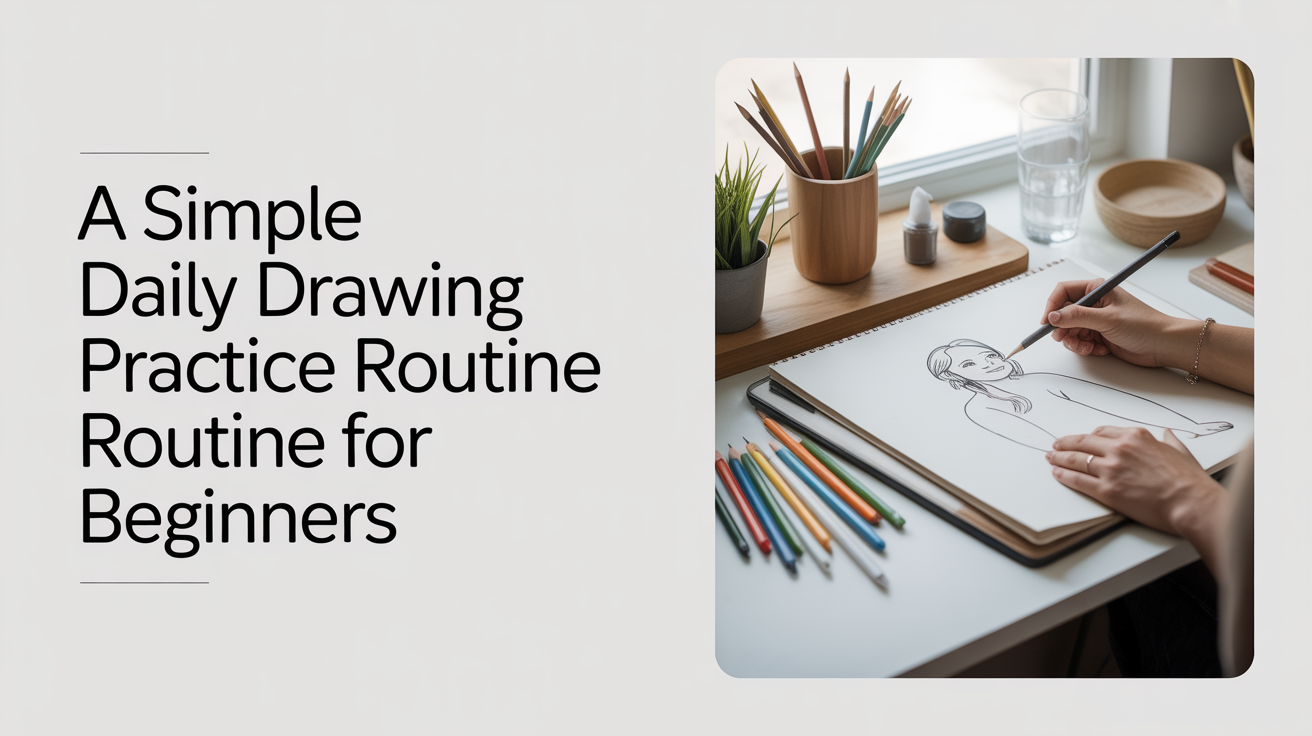
A consistent drawing practice routine matters far more than long, infrequent sessions. Even fifteen minutes a day will teach your hand and eye things that a three-hour weekend marathon cannot, because repetition over time is how motor skills form. This guide gives you a concrete, low-pressure structure you can start today.
Why Regularity Beats Duration
When you draw every day, even briefly, you are reinforcing the connection between what your eye sees and what your hand does. That link is a physical skill, not a talent. It gets stronger through repeated small doses, the same way a musician improves by playing scales each morning rather than only on weekends.
Short daily sessions also lower the psychological barrier. Sitting down to "draw for an hour" can feel like a commitment; sitting down to "draw for fifteen minutes" feels manageable. Manageable things actually happen.
There is one more benefit: you will notice your own progress faster. If you draw every day and compare this week's pages to last week's, the improvement is visible. That visibility is motivating in a way that scattered sessions never quite produce.
If you are still deciding whether drawing is even for you, start here with the absolute basics for complete beginners before building a routine around it.
A 15–20 Minute Daily Drawing Practice (Step by Step)
This routine has three parts. You can time them loosely; the numbers are guides, not rules.
-
Warm-up (3–5 minutes). Fill half a page with loose marks: long diagonal lines from corner to corner, ellipses (flattened ovals) in different sizes, and a row of smooth curves. The goal is not precision. You are warming up your shoulder and wrist and reminding your hand that it is in drawing mode. Draw from the shoulder for the long strokes, not from the wrist — it produces steadier lines and reduces cramping.
-
Focused drill (8–10 minutes). Pick one specific skill to work on. This is the heart of a good drawing practice routine. Examples of focused drills:
- Line control: Draw pairs of dots on the page, then connect them freehand in a single confident stroke. Aim for a clean line, not a sketchy, overworked one.
- Basic shapes: Fill a page with boxes drawn in perspective, or with circles of varying size. The goal is consistent shape, not perfection.
- Shading gradients: Draw a rectangle and shade from dark on one side to light on the other using only the pressure of your pencil (no erasing).
- Contour drawing: Trace the outline of an object in front of you (a mug, a shoe) without lifting your pencil. This trains you to look at edges, which is one of the core skills behind every drawing.
-
Fun drawing (5 minutes). Draw something you actually want to draw. No drills, no rules. This keeps the practice enjoyable and is where you start applying what the drills are teaching. A plant on your windowsill, your own hand, a character from your imagination — anything goes.
That structure is the whole routine. Warm up, drill one thing, draw something fun. Repeat tomorrow.
A Sample Weekly Plan
Rotating your drills means you develop multiple skills in parallel rather than overworking one area.
| Day | Focused Drill |
|---|---|
| Monday | Line control (dot-to-dot strokes) |
| Tuesday | Shapes (boxes or cylinders from different angles) |
| Wednesday | Contour drawing (real object in front of you) |
| Thursday | Shading (gradient rectangles, hatching) |
| Friday | Negative space (draw the space around an object, not the object itself) |
| Saturday | Free choice (revisit a drill that felt hard) |
| Sunday | Rest, or just doodle freely with no structure |
You do not have to follow this exactly. It is a starting point. After a few weeks you will notice which drills you find frustrating (usually the ones you need most) and which feel easy (usually the ones you can safely spend less time on).
How to Build the Habit
The biggest obstacle to daily drawing practice is not skill; it is forgetting or not setting up the conditions for it to happen. A few things that help:
Keep your sketchbook visible. If it is in a drawer, you will not open it. Leave it on your desk or table with a pencil already on top of it. The lower the friction, the better. This one change makes more difference than any motivational advice.
Attach it to something you already do. Drawing right after your morning coffee, or right before bed, uses an existing habit as an anchor. You do not have to find motivation from scratch; you just follow the existing sequence.
Decide in advance what you will drill. The weekly plan above removes a small but real decision from each session. Decision fatigue is real, and "what should I practice today?" is enough friction to make someone close the sketchbook and check their phone instead.
Missing a day is fine. It genuinely is. One skipped day does not erase what you have built. Just open the sketchbook the next day and continue. The only mistake is treating a missed day as a reason to stop altogether.
How to Track Progress Without Judging Early Work
One of the most useful things you can do is date every page of your sketchbook. This costs nothing and gives you a time-stamped record. After four to six weeks, flip back to your earliest pages. The difference will likely surprise you.
Avoid comparing your drawings to other people's work, especially online. What you see on social media is almost always the work of someone with years of daily practice, or a highlight reel of their best pieces. It is not a fair baseline for week two of your routine.
A better comparison: this week versus last week. That is the only gap that matters. You are not competing with anyone else's timeline.
Some beginners find it helpful to photograph their pages weekly, not for sharing, but for their own record. A phone photo takes five seconds and gives you a scrollable history of your improvement. It also makes the progress concrete in a way that memory alone does not.
Part of what makes drawing improve is learning to see, not just to copy. That skill has its own learning curve, and understanding it will accelerate everything else in your practice. This article on learning to see explains why observation is the core of every drawing skill.
Small Adjustments That Pay Off
The way you hold your pencil affects your line quality more than most beginners expect. A tight grip near the tip produces stiff, scratchy marks. Holding slightly back from the tip and loosening your fingers gives you smoother, more controlled lines. How to hold a pencil for drawing covers this in detail and is worth five minutes of your time before your next session.
Similarly, the grade of pencil you use changes what is possible. An HB (the standard "number 2" pencil) is a reasonable starting point, but a 2B or 4B gives you a darker, softer line that is better for shading. You do not need to buy anything special yet; just be aware that "pencil" is not one thing, and your tools affect your results.
Frequently Asked Questions
How long should I practice drawing each day? Fifteen to twenty minutes is enough for a beginner. That is short enough to actually do every day, and long enough to make real progress. You can always extend a session when you are in the flow, but build the habit around the shorter time first.
What if I miss several days in a row? Pick up where you left off. There is no streak to protect here. Consistent practice over months matters far more than perfect daily completion. Even three or four sessions a week will compound into real skill over time.
Do I need a special sketchbook or pencils to start? No. A cheap spiral notebook and a standard pencil are enough. The tools improve your experience once you know what you want, but they are not what produces improvement — the drawing is.
I feel like my drawings look bad. Is that normal? Yes, and it means your taste is ahead of your technical skill, which is exactly where every beginner starts. The gap closes through practice. Your eye learns to see what good drawing looks like long before your hand can reproduce it. Keep going; the hand catches up.
Should I follow a course or just free-draw each day? A structured course or set of exercises is more efficient than pure free-drawing, because it makes sure you practice the specific skills (line, shape, value, proportion) that underpin everything else. Free drawing is still valuable, which is why the routine above ends with five minutes of it. The combination of both is better than either alone.