Perspective & Composition
Two-Point Perspective Explained Simply
Learn two point perspective for beginners: set up a horizon line, place two vanishing points, and draw convincing boxes and buildings step by step.

Two-point perspective uses two vanishing points sitting on the horizon line, and converging lines that run toward each of them from a vertical edge. It is the go-to method for drawing corners of buildings, city streets, and any box viewed at an angle. Once you can feel how those two sets of lines pull toward opposite ends of the page, a lot of drawing suddenly makes sense.
If you have not read about the horizon line and vanishing points yet, The Horizon Line and Vanishing Points Made Simple is a good place to start before continuing here.
A Quick Recap: Horizon Line and Vanishing Points
The horizon line is an imaginary horizontal line that sits at eye level. It represents the height at which your eyes are looking straight ahead. Everything above it tilts down toward it; everything below tilts up toward it.
A vanishing point (VP) is a dot on that horizon line where parallel lines appear to meet as they recede into the distance. In one-point perspective, there is a single vanishing point directly ahead of you. That works for hallways or roads heading straight away.
Two-point perspective adds a second vanishing point. One sits to the left on the horizon line, one to the right. Instead of seeing a flat face head-on, you are now looking at a corner, with two sets of surfaces angling away from you in opposite directions. Each set of surfaces has its own vanishing point.
Key terms at a glance:
| Term | What it means |
|---|---|
| Horizon line | Horizontal line at your eye level |
| Vanishing point (VP) | Dot on the horizon where parallel lines converge |
| Converging lines | Lines that run from an object toward a vanishing point |
| Vertical edge | The nearest corner of the object; stays perfectly vertical |
How to Draw a Box in Two-Point Perspective
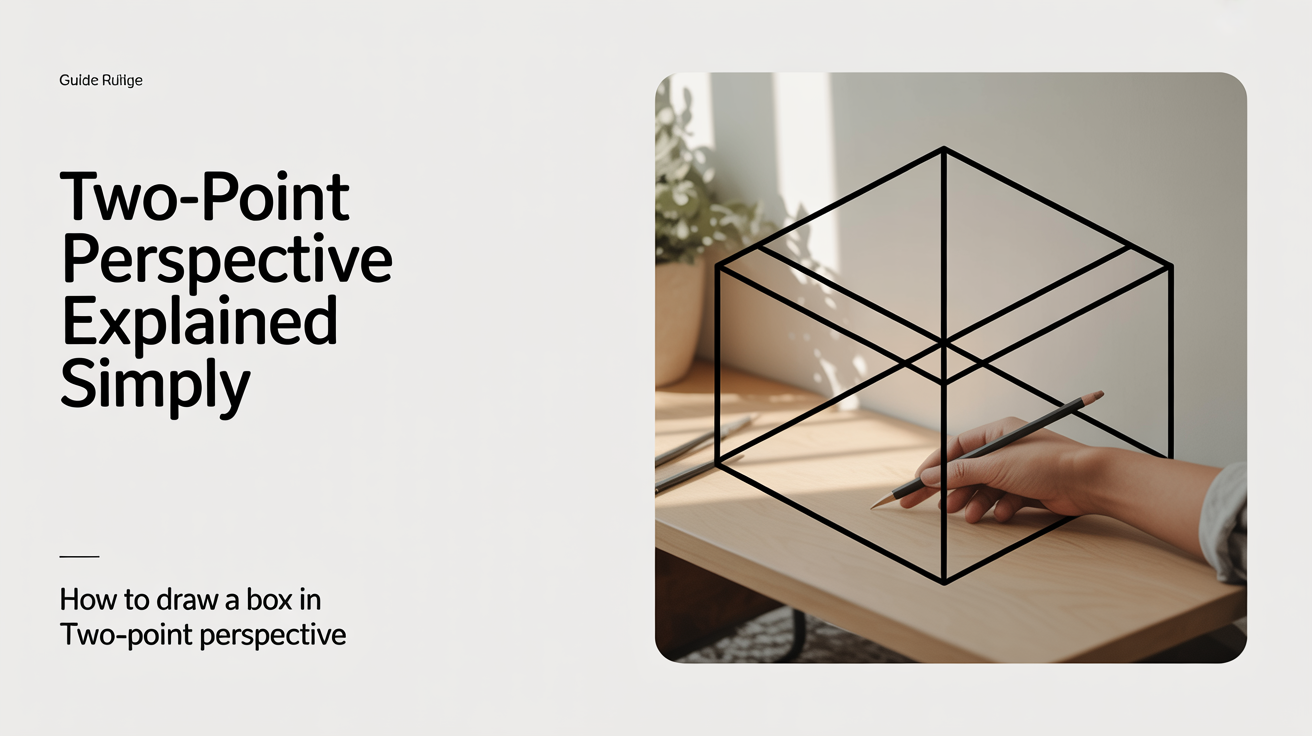
This is the foundational exercise. A box in 2 point perspective teaches you everything: how the lines move, where to place the vanishing points, and how to control the sense of height and depth. Do this several times on large paper with a ruler before moving to freehand.
What you need: a sheet of paper (A4 or larger), a ruler, a pencil, and an eraser.
-
Draw the horizon line. Rule a long horizontal line across the page, roughly in the middle. Label it "HL."
-
Place two vanishing points. Mark a dot near the left end of the horizon line and another near the right end. Label them VP-L and VP-R. The farther apart they are, the less distorted your box will look. Beginners often place them too close together (more on that shortly).
-
Draw the vertical edge. Somewhere between the two vanishing points, draw a short vertical line. This is the front corner of your box, the edge closest to you. Its height controls how tall the box appears.
-
Draw the top converging lines. Using your ruler, draw a light line from the top of the vertical edge toward VP-L, and another from the same point toward VP-R. These define the two top edges of the box as they angle away from you.
-
Draw the bottom converging lines. Repeat from the bottom of the vertical edge, one line toward VP-L, one toward VP-R. You now have an "X" shape with the vertical edge in the middle.
-
Add the back vertical edges. Decide how deep you want the box on each side. Pick a point along the left set of converging lines and draw a short vertical line there. Do the same on the right side. These are the back corners of the box.
-
Close the top. From the top of the left back corner, draw a line toward VP-R until it meets the right set of converging lines. Do the same from the right back corner toward VP-L. Where those lines intersect is the far top corner of the box.
-
Erase the construction lines. Clean up the lines that run past the box edges, and you have a solid two-point perspective box.
Once this feels comfortable, try placing the vertical edge above the horizon line (you are looking up at the box from below) or below it (you are above, looking down). The method is identical; only the edge's position changes.
Drawing a Simple Building or Street Corner
A building is just a taller, wider version of the box exercise. The main difference is that you are usually looking at it from street level, so the horizon line sits relatively low on the page.
Steps for a basic building corner:
-
Set your horizon line low, about one-quarter of the way up the page. Place VP-L and VP-R well outside the page edges if possible (tape the paper to a larger sheet and mark the VPs on the surrounding area). This dramatically reduces distortion.
-
Draw a tall vertical line near the center for the front corner of the building.
-
Pull converging lines from the top and bottom of that vertical toward each VP.
-
Add back vertical edges to define the building's width on each side.
-
Close the roofline with lines running between the back corners toward the opposite VPs, just as with the box.
-
For windows and doors, run horizontal lines parallel to the existing converging lines (they all share the same VP on their side) and add vertical lines for the sides of each opening.
The rule that makes buildings feel real: every horizontal edge on the left face of the building goes to VP-L, and every horizontal edge on the right face goes to VP-R. No exceptions.
For more on how this connects to drawing foreshortened shapes, see What Is Foreshortening and How to Draw It.
Common Mistakes (and How to Fix Them)
Two-point perspective trips people up in predictable ways. Here is what to watch for.
Vanishing points too close together. This is the most common mistake. When VP-L and VP-R are close, the converging lines hit the edges at steep angles and the box looks wildly distorted, almost like a fish-eye lens. Push the points farther apart, ideally off the edge of the paper. As a rule of thumb, the distance between your two VPs should be at least two to three times the width of the object you are drawing.
Vertical lines that are not vertical. Every vertical edge of your box or building must be perfectly straight up and down. Beginners sometimes let them angle slightly, which makes the structure look like it is falling over. Use the ruler for vertical edges, at least while learning.
Mixing up which VP controls which face. If you send a line from the right face toward VP-L, the box collapses into nonsense. Slow down and check: left face goes left, right face goes right.
Drawing the top and bottom as horizontal. The top and bottom edges of the box are NOT horizontal, they converge toward the VPs. Only the vertical edges stay truly vertical. This is a surprisingly common slip when sketching loosely.
Lines that do not actually meet at the VP. Small angle errors compound over a large drawing. Check your lines by holding the ruler at the VP and sweeping it across, does every line on that face pass through the same point? If not, redraw.
Frequently Asked Questions
What is the difference between one-point and two-point perspective? One-point perspective has a single vanishing point and is best for views where you face a surface straight on (a hallway, a road heading directly away). Two-point perspective has two vanishing points and is used when you are looking at a corner, which gives you two sets of surfaces angling away in different directions. Two-point is more common in architectural and urban sketching because we rarely face buildings head-on.
Where should I put the vanishing points? As far apart as your paper (or tape extension) allows. When learning, many people keep both VPs on the horizon line within the page, but this causes the distortion described above. A practical habit is to tape your paper onto a larger piece of card and mark the VPs out on the surrounding area, then your drawing stays clean while the geometry stays accurate.
Does the horizon line always have to be in the middle of the page? No. The horizon line is your eye level, and you can set it anywhere. A low horizon line (near the bottom of the page) gives a dramatic upward view, as if you are standing at the foot of a tall building. A high horizon line (near the top) gives a bird's-eye feel, looking down on the scene. Moving the line is one of the simplest ways to control the mood of a composition.
Can I use two-point perspective for objects other than buildings? Yes. Any box-like object, a book, a table, a shipping crate, a car body, follows the same rules. Two-point perspective is especially useful for furniture and product sketching. Once you can draw a convincing box, you can simplify almost any object into a box first, then add the details on top.
My box looks stretched or squashed. What went wrong? The most likely cause is that the vertical edge is too tall or too short relative to the depth shown by the converging lines. Try adjusting the height of the vertical edge, or move the VPs farther apart. If one face of the box looks much steeper than the other, the vertical edge may be sitting too close to one of the VPs, keep it roughly centered between them when you are learning.